
Seeking Continuity
A while back, we talked about shielding the cavities and pickguard of a guitar to help quiet it and prevent it picking up noise from the environment. As part of that, I mentioned the importance of ‘continuity’ between the various shielded parts and ground. Most people grasped what I was getting at but I got a couple of questions asking if I could go into a bit more detail. I meant to return to it earlier. Then I forgot. 😄
What is electrical continuity?
Continuity is the the property of having a continuous path on which an electrical signal can travel.
Continuous ➞ continuity, right?
And, when we remember that our wonderful guitar signal is just electricity, we can expect to see continuity between components in our guitar. We expect to see it along the wires from our pickup to our volume pot. We expect it from our pot to—and through—our switch, to the output jack and, from there, we expect it through our lead/cord to our amp. Without that continuity, the pickup signal can’t make it through.
Continuity: Defined. Ok, see you next week.
Nah. We can’t really stop there. We need to go a little further on this. While that definition above is fine, when we’re working on guitars (or anything) and we’re using a multimeter to do some troubleshooting, we have to throw in another parameter to define continuity.
Continuity is a continuous, low-resistance, path for an electrical signal.
We add this qualifier because the multimeter’s continuity function generally expects to see very little electrical resistance when it tests.
So what is electrical resistance?
Resistance is a property of a material that makes it harder for an electrical signal to pass through. Electricity is just a flow of electrons, trundling along a conductor like a wire.
Imagine you’re the electron and you’re walking along an empty street at 5am… No problem. You can make your way to your destination without any hassle. Yay. You’ve travelled the low resistance route. Imagine the same street in the middle of rush-hour. In all the buildings along the street people have just finished work and thousands of them are out on the street heading for different places. You’re trying to pick your way through them, being jostled about. It’s a much harder journey. And for a travelling electron, resistance in a material makes its journey more difficult too.
Pretty much everything has some electrical resistance. Materials with a relatively lower resistance, like copper wire, we can use to carry electricity where we want it. We call these types of materials conductors. Other materials offer so much resistance that they make it incredibly difficult—almost impossible—for electricity to pass through. We call those insulators (the pvc coating around a copper wire is a good example).
Getting back to continuity being a ‘low-resistance’ path…
When we’re testing things with a multimeter using the continuity function, the meter expects a very low—almost negligible—amount of resistance in order to signal that a continuous path exists. Pop one probe at one end of a wire and the second probe at the other end and the meter beeps, indicating there is electrical continuity between those two points. Great.
And that’s why, when I was talking about where we expect to see continuity in our guitars, I mentioned between pickup and pot; between pot and switch. Some components bring their own resistance and you can’t really test them with a continuity tester. More on that another time. Continuity testing on a meter is great for quickly indicating if electricity (your pickup signal) can travel from one point to another without meeting any real resistance.
So, back when I began introducing this email (and waaaaay back when I talked about continuity between the shielded parts and ground), this is what I meant: An easy electrical path from any of the shielding right back to a ground point in the guitar (and, ultimately, through the amp to actual ground). Any environmental interference that’s intercepted by the shield can travel all along that path with negligible resistance so it never makes its way to some of the hot stuff that can be picked up and amplified.
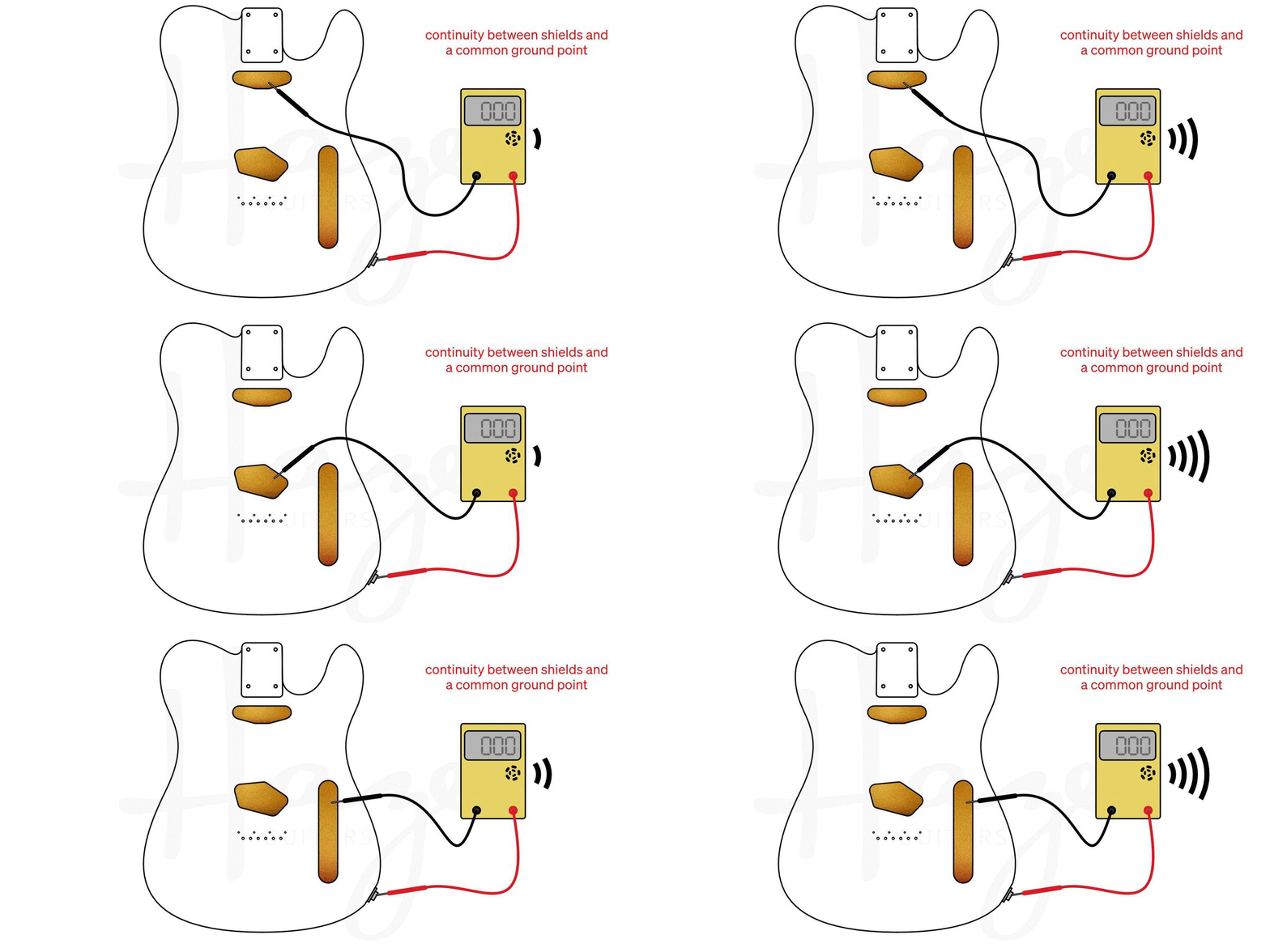
To test your shielding, set your meter to its continuity function, touch one probe to the output jack ground/sleeve and touch the other to a number of random points on the various shields. Each point should give you a reassuring beep to indicate there is continuity between the shield and ground.
We’ll expand this stuff out a little more next time.
This article written by Gerry Hayes and first published at hazeguitars.com







Gibson’s addition of PCBs gets a lot of criticism. Is it justified? Mostly no but with a little bit of yes.