
Fancy-Pants Tuners. Do you need one
Strobe tuners are fantastic—accurate to .1 of a cent. That's pretty damned accurate. And the crazy, analogue throw-back way a strobe tuner works is fantastic.
The heart of a traditional strobe tuner is a disc, printed with a succession of finer circle divisions. The inner circle is divided into four segments, alternately coloured black and white. The next circle out doubles this to eight segments, the next to sixteen, and so on. There's a depiction below if you want to stare at it and make your eyes go a bit weird.
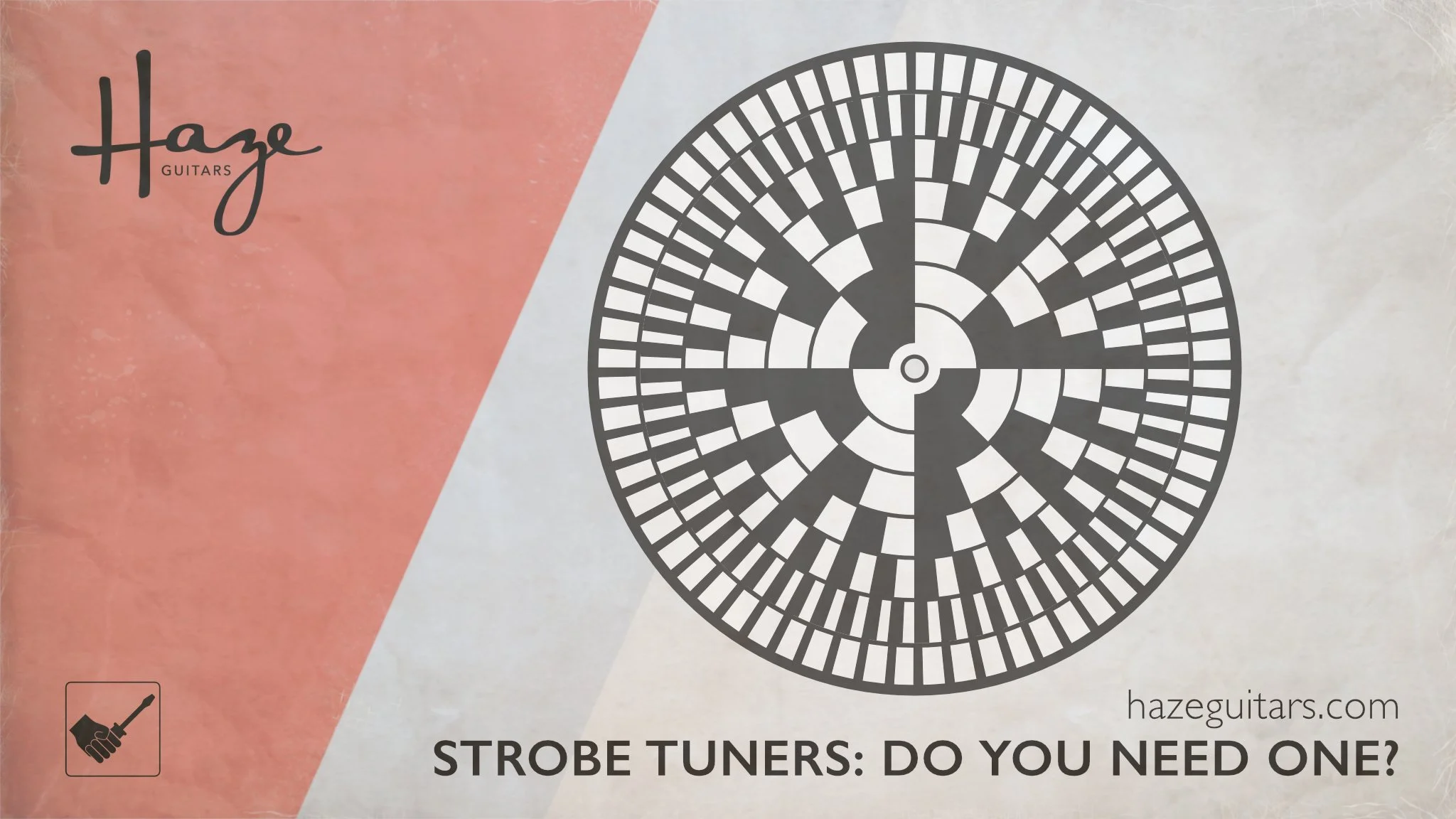
Strobe tuner disc
Inside the tuner, a motor spins this disc at a particular speed (number of revolutions per second) depending on the note selected. Under normal circumstances the printed segments on this rapidly spinning disc would just appear to be a series of blurry grey circles. That's where the 'strobe' part comes in.
The stroboscopic effect is a weird visual phenomenon that makes motion appear slower, static, or even reversed when we see it as a series of discrete images rather than in the continuous flow of the 'real world'. Everyone's experience this. It's most well known (to a particular generation who watched cowboy movies) as the Wagon Wheel Effect. The continuous movement of a spinning wagon wheel can appear to slow, stop, or reverse when captured at the 24 frames per second of a movie camera. You might also have seen it with things like plane propellors on camera or even vibrating guitar strings. The stroboscopic effect is weird and potentially dangerous in some circumstances—in certain machine shops, you need to be careful of the type of lighting used as some lights can produce a very fast flicker that could make spinning machine parts appear as if they're not moving. However, if you want to tune something, it can be pretty useful.
That spinning disc with the blurry grey circles, for instance. If you light that with a lamp that flashes rapidly, the stroboscopic effect can make the segments start to slow or even stop.
In a strobe tuner, the disc speed is set depending on the note selected and the lights are flashed depending on the frequency of the input signal. Select an A and the disc spins at a rate that's some suitable fraction of 440 (the frequency of an A note). The light flashes depending on the note you strum on your guitar—somewhere around 440 times a second if you're close to tune. As you turn the tuner, the flashing light frequency changes . The segments on the spinning disc appear to speed up (if you get further from in-tune or slow down (as you get closer to being in tune). When the light flashes exactly 440 times a second, the disc appears to be still, even though it's still spinning as normal. You're in tune. And, because of the relatively simplistic, mostly analogue nature, you're pretty damned accurately in tune.
Some modern strobe tuners use LCD screens instead of spinning discs but they operate on a very similar principle. The display is refreshed at the appropriate frequency for the note being tuned and they are as accurate as the old style with an actual spinning disc.
So, it stands to reason you should get a strobe tuner, right?
I had this question a while back:
"I see so many of those super high end Peterson strobe tuners on luthier’s benches. Are those necessary? I want to get some input before I spent a huge amount for one."
My reply was this:
"The short answer is no. They're not necessary. So why do so many luthiers have them (myself included)? When someone's paying you to do a job you (a) want to do the most accurate job possible and (b) want to look like you're doing the most accurate job possible." 😄
That's flippant and reductive but mostly fair. You don't need a strobe tuner for most jobs, including setup. If you get a decent electronic tuner, you'll be fine. Most tuners are accurate to around 1 cent these days and that's below the perception level of almost everyone (maybe everyone). If you do this for a living, you'll probably find things like setting intonation easier with a strobe display and its finer divisions but a guitar is not a perfect instrument for tuning and intonation. Fretting a note a little harder will probably pull out the tuning more than the difference between a stobe and regular tuner. If the guitar was to be played by precisely made robot fingers, equipped with sophisticated sensors and delicate servos, maybe that accuracy is essential but most of the time it's not.
Now, all of this is not to say you won't get more accurate tuning with a strobe tuner. You will. Definitely. And, if you really want one, go for it. They're great. But, similar to what I wrote about quests a while back, you might not need that. Maybe if you're Def Leppard, you can go buy a strobe before heading to the studio. For most everyone else, most of the time, a decent tuner will probably be fine.
P.S. I'm not sure why I picked on Def Leppard, there. For some reason that's just what came out as I was typing. Make of that what you will. 😄
This article written by Gerry Hayes and first published at hazeguitars.com







Gibson’s addition of PCBs gets a lot of criticism. Is it justified? Mostly no but with a little bit of yes.