
It's All About The Tone
I was going to move away from the electrical stuff for a bit but, after last week’s chat about pots and volume controls, it seemed to make sense to talk about your tone control. It all works better as a package.
Given that you know there’s a knob on the guitar for the 'tone' job, I’m sure you’ve figured out there’s a pot involved. And there is. We also add another important component, though: The capacitor.
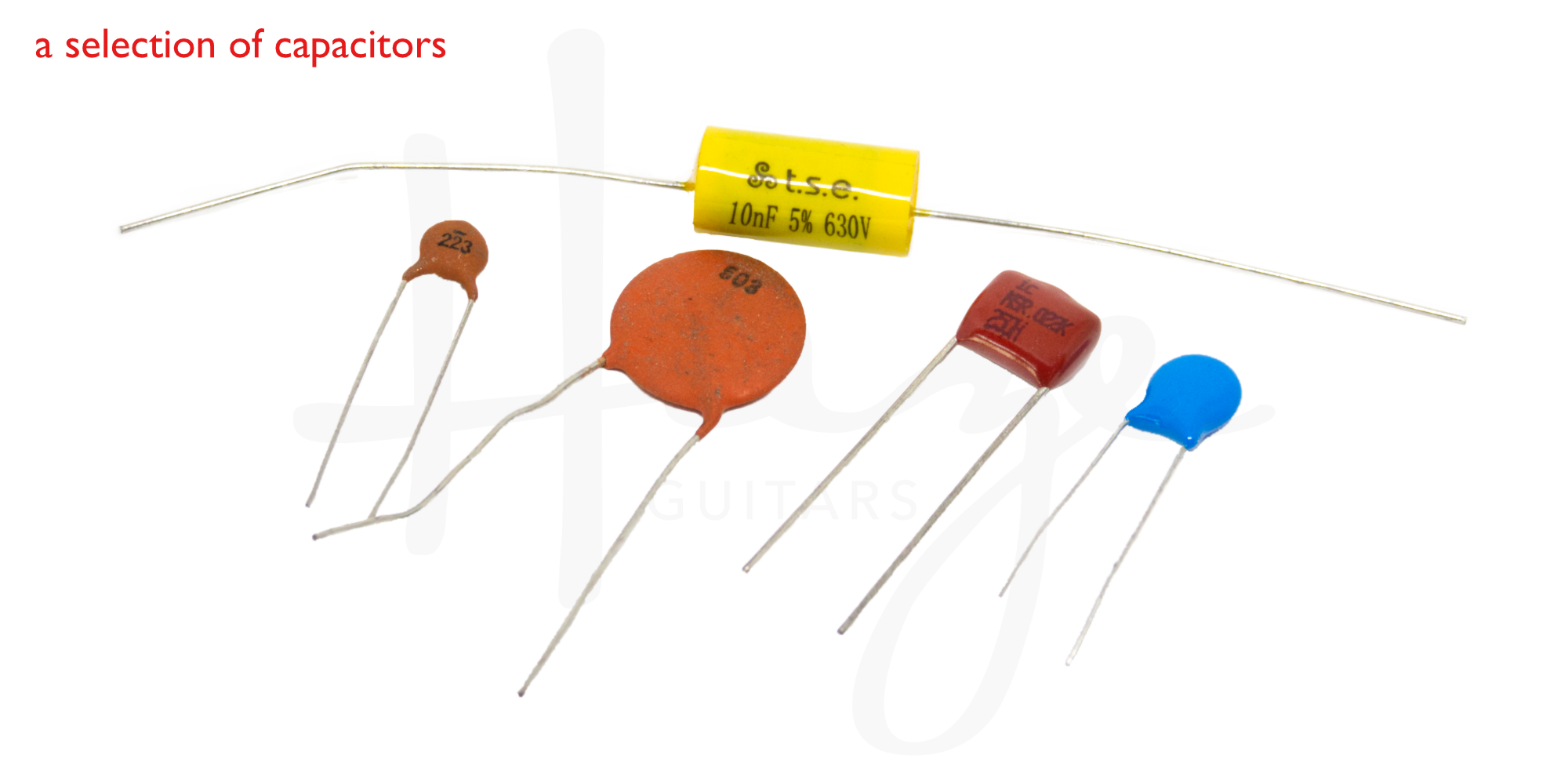
A selection of capacitors
A capacitor is a little electronic component that—as well as other jobs—can act as a filter for certain electrical frequencies. If you shoot a signal at a capacitor, it will block frequencies below a certain value and only allow frequencies above that value to pass through.
The point at which frequencies begin to get passed depends on the capacitor’s value. We don’t need to get too deeply into those values right now but here’s a super-quick primer. Capacitance is measured in units called Farads (abbreviated to F) and that the values we use most often in guitars are a tiny fraction of 1 Farad—they’re way down in the microFarad range (millionths of a Farad). We use the lowercase Greek letter mu to indicate ‘micro’ so you might see a capacitor described as being 0.1µF (or 0.1 microFarads).
So, different values of capacitors move the point where frequencies can pass through them. In our guitars and basses, we can use this to pass those higher frequencies to ground, killing them off.
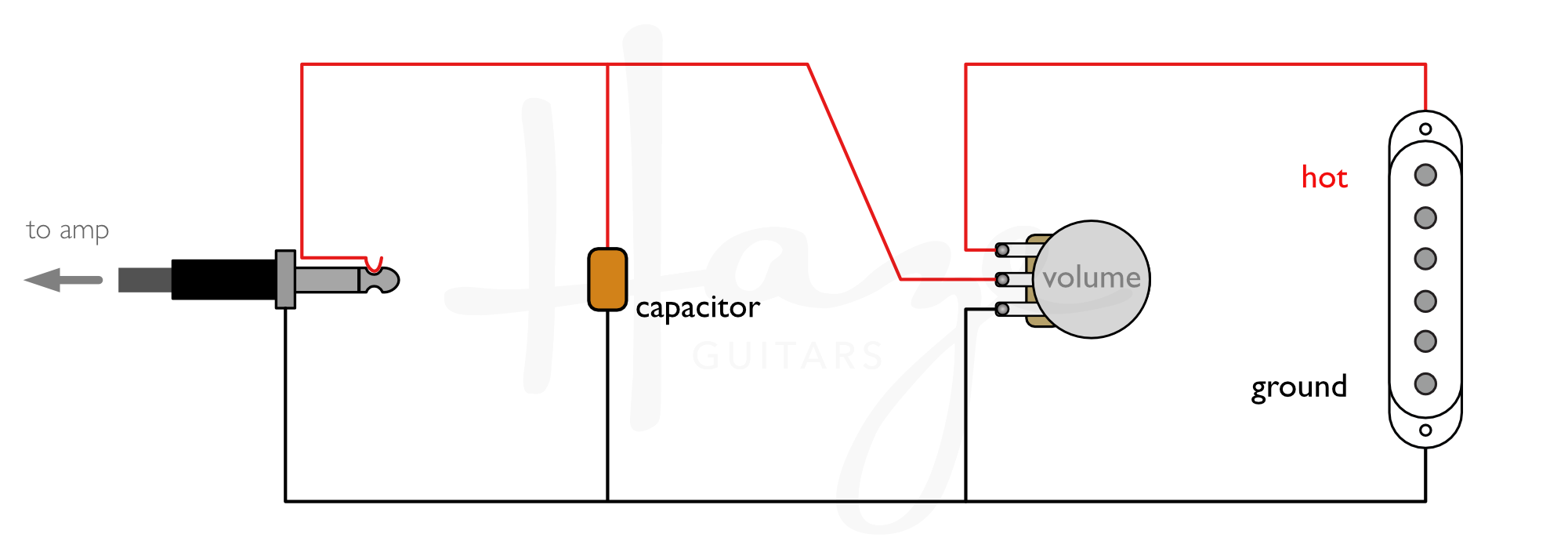
Adding a capacitor as a sort of ‘fixed’ tone filter.
If we expand our circuit from last week, we could throw a capacitor into the mix between the hot wire and the ground wire. What that will do is allow higher frequencies to pass through from the hot signal to ground before they ever make it out to the amp. Suddenly our signal has less high frequency content and we hear it as being warmer/bassier/muddier/etc. You could think of the arrangement shown above as a fixed tone control.
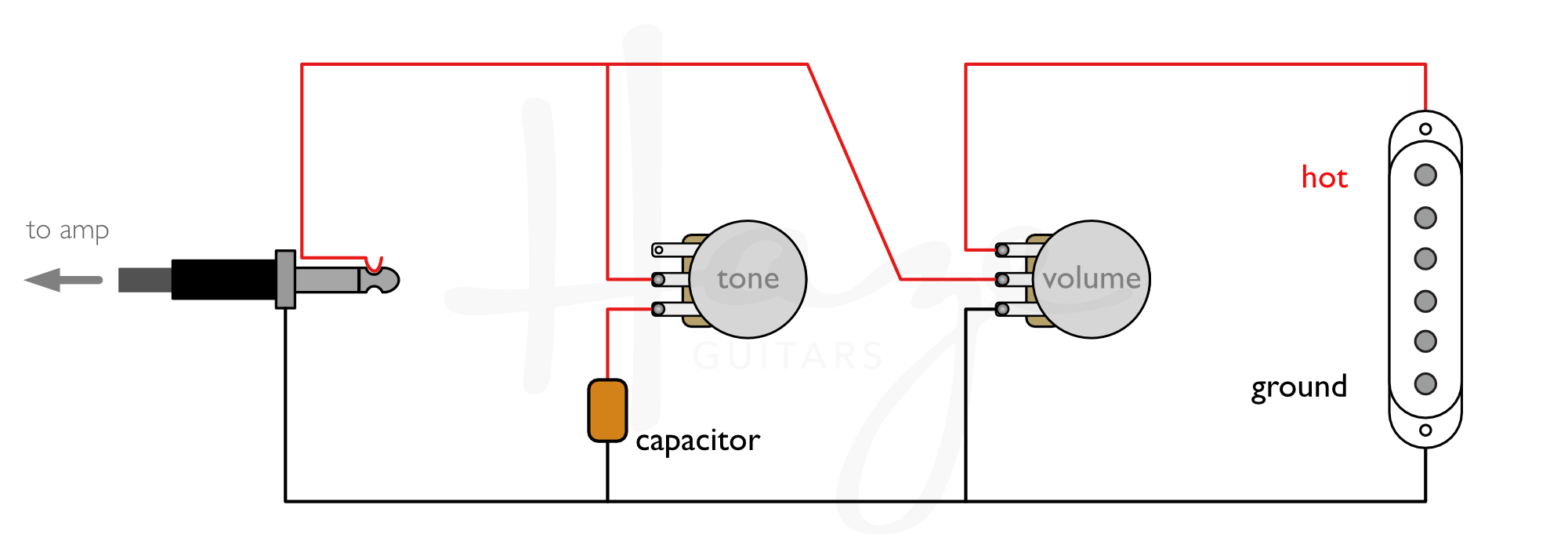
Adding a pot to help control the ‘tone’
Adding a pot (a variable resistor) with the capacitor makes things a little more useful. That’s going to let us control how much of our signal the capacitor is allowed to see.
There’s a subtle point here but it’s an important one. The pot does not control the point in the frequency range which the capacitor lets a signal through. That point is set with the capacitor and can’t be changed. A capacitor of a particular value will pass frequencies above a particular point. The pot controls how much of our signal is allowed to reach the capacitor to actually get passed through. With the tone control pot at 10, practically none of the signal gets through the pot to make it to the capacitor. With the tone control turned down to zero, all of our signal makes it to the capacitor and the capacitor then filters off the higher frequency part.
It’s worth my noting, before leaving the subject, that tone controls can be wired in a lot of different ways. You wouldn’t think a single pot and capacitor could have such variety. Importantly, though, there’s no difference from an electrical signal’s point of view. The capacitor controls what frequencies are allowed through and the pot controls how much is allowed through. All the different wiring variations sound the same. The only things that alter the sound (the ‘tone’) are the capacitor value and (to a lesser extent) the pot value.
I’m usually very happy to hear from people who read my stuff so feel free to use the Contact page if you want to chat. However, this time there’s a slight ‘qualifier’ on this offer. If you feel an urge to proselytise about the types of capacitor you like, I’d prefer not to. 😄 No offence meant. If you like the expensive paper-in-oil, military-spec capacitors, brilliant. You do you. I can’t hear a different in types of capacitor (value: yes, type: no). If you can, fantastic. Go for it. I’m too old and too tired to get into discussions on it. We can all get along without trying to convert each other on this one.
Hakuna matata. 😄
And now a quick plug: If you find this stuff interesting, you'll probably enjoy my book, Complete Guitar Wiring. It's 400 pages worth of useful information to help understand and work on your guitar and bass wiring. It's good—people are saying nice things about it. 🙂 There's a digital version and a print version (or search your local Amazon for Complete Guitar Wiring or the ISBN 978-1919649429).
This article written by Gerry Hayes and first published at hazeguitars.com






Gibson’s addition of PCBs gets a lot of criticism. Is it justified? Mostly no but with a little bit of yes.