
The problems swapping direct-mount humbuckers
Last week, I talked about pickup body mounting, and foam, and whatnot. It seems to make sense to follow that with some discussion on a related issue—one that has the potential to bite unsuspecting pickup upgraders in the ass.
If you’re upgrading and swapping pickups, you should probably give at least some cursory consideration to whether the new pickup will actually fit the space where the old one lived. Mostly, it’s either no problem—sticking a new humbucker in your Les Paul, for instance—or completely obvious that you’ll need to do some routing and modifications—shoehorning a humbucker into a Tele.
Sometimes guitars are more sneaky, though. Sometimes, you'll assume all is well and all won't be quite so well. Let's talk about one of my current bugbears.
Direct-mount humbuckers
Or, you could say 'body-mount' if you wanted. I tend to because 'direct-mount' sounds a bit like a marketing term rather than anything meaningful. But, I'm not here to rant about what things are called. I'm here to rant about the fact that there are no real standards for pickups and that can sometimes cause much weeping and gnashing of teeth in players who've bought a new pickup and expected it to drop nicely into the hole where the old one was.
Here's the problem: Not all humbuckers are the same. Yes, the basic footprint is pretty similar but there are variations in construction that make things difficult for body-mounting them.
Regular humbucker cavities (like on a Les Paul, for example) have a little 'slack' in them. There's usually a bit of space around the pickup and under the pickup. Because the pickup is suspended from a plastic pickup mount, it's easy to adjust and the mount covers the routed cavity. Since it's hidden away, it can have that little extra space.
Not so for direct mount. Those cavities are generally a tighter fit around the humbucker. Aesthetically this makes sense and, to be honest that's not really the big issue (except in one case that I'll get to in a minute). The main problem is the cavity depth.
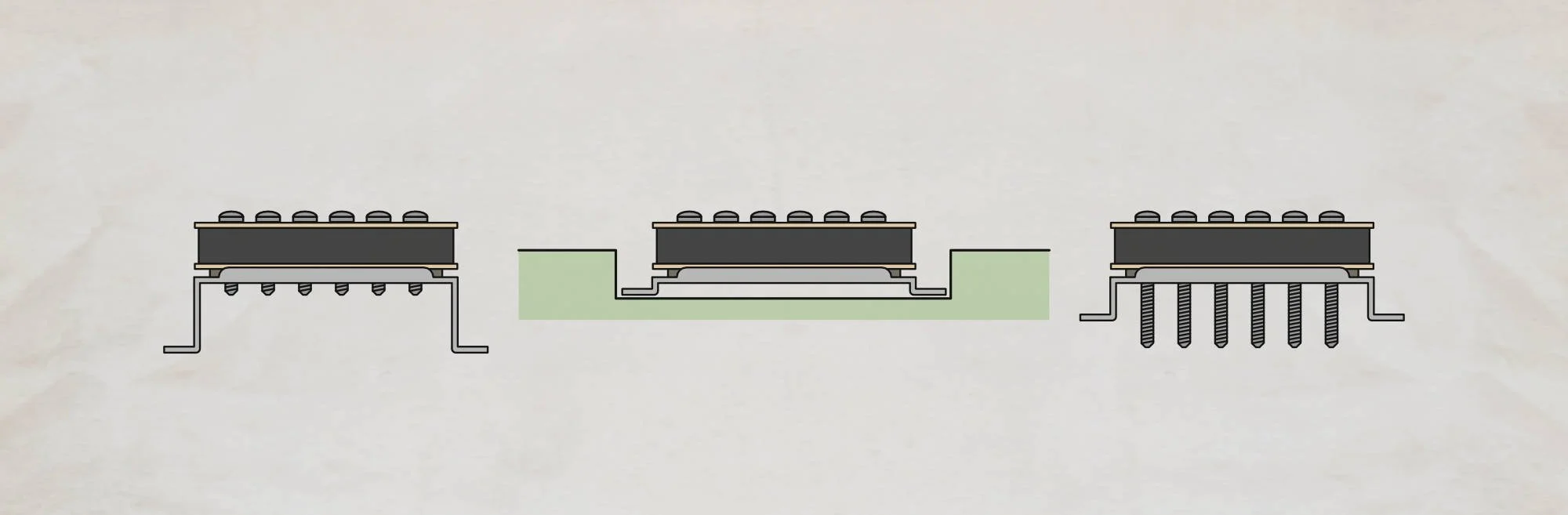
The biggest differences in humbuckers tend to be evident in the vertical plane. Coils can be made taller. Pole piece screws can be longer and protrude further out the bottom of the pickup. The legs on the pickup mounting lugs can be longer on some humbuckers than others.
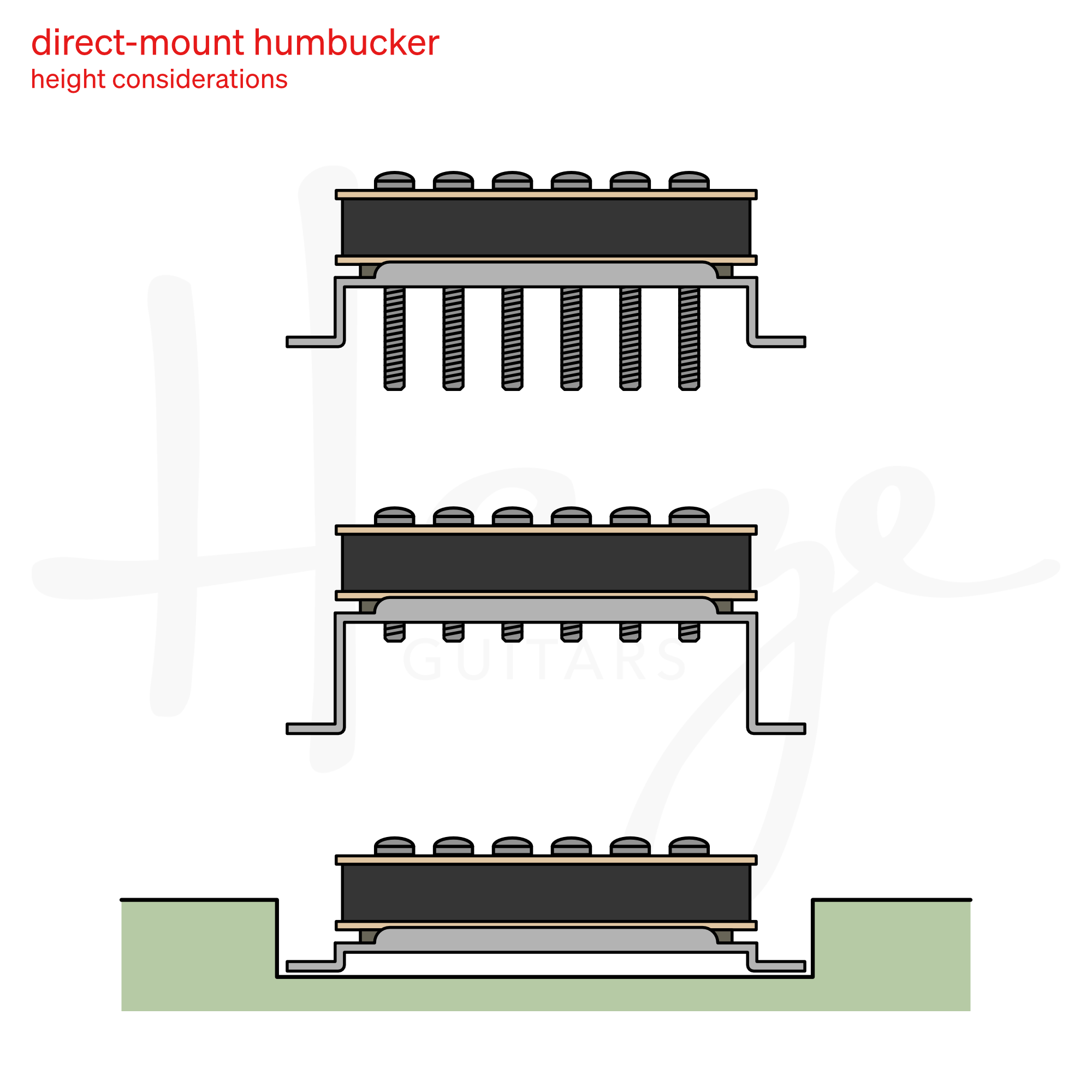
Different styles of humbucker can be problematic if direct mounting
Imagine you've a guitar routed with a cavity to body-mount the bottom pickup. All nice and neat until you want to mount either of the examples above it. Now this is all nothing that can't be solved by a bit of routing. For repairers like me, it's everyday stuff and not a problem. However, a lot of players are used to assuming that a humbucker-to-humbucker upgrade is a straight swap and this can very easily catch them out. Instead of a straightforward soldering job, they have to start routing or (more usually) they're on the hook for the cost of having someone else do it. It's a bit annoying and something that I think more players should be aware of.
Even more annoying (in my view, anyway) is the other point I said I'd get to—where the tighter fitting 'outline' of the cavity causes a problem…
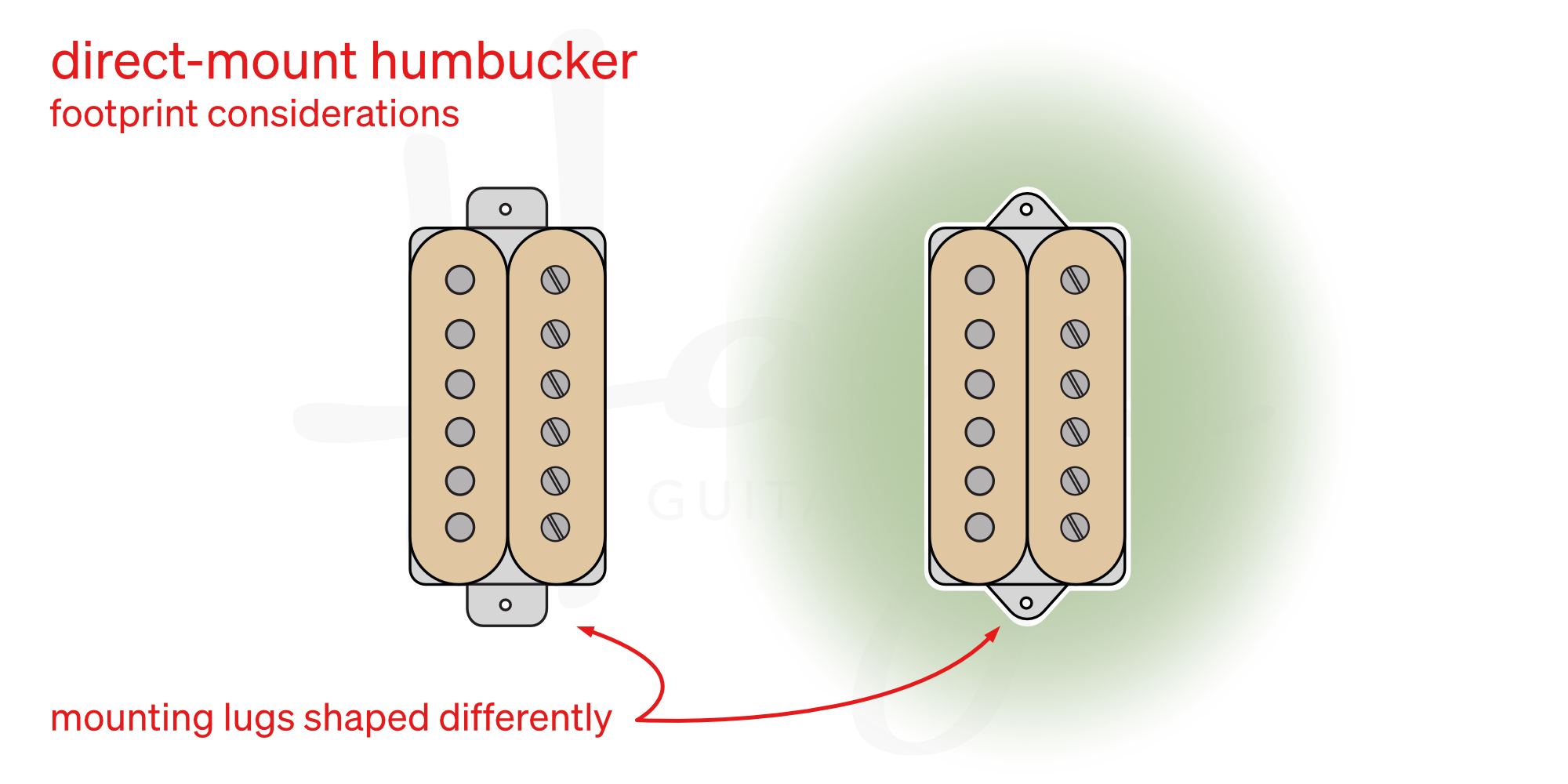
Pickup mounting lugs can be a different footprint
Some makers have changed the shape of their humbucker mounting lugs. Now, there's probably no argument that the rounded-triangle shape looks better when it's body-mounted. But, it's another hurdle for the unsuspecting pickup upgrader. The (more traditional and more common) squared-off mounting lugs on the left won't fit nicely into a cavity routed for the triangular lugs. It's possible to use a file to modify the traditional lugs but it's not perfect.
I'm not some mill-burning luddite here. I'm ok with stuff progressing and, for most repairers, this isn't more than another minor annoyance. Like I say, though, a lot of DIYers are used to straight-swapping one humbucker for another. That's potentially more troublesome with direct/body-mount humbuckers and it's useful to consider if you're someone who enjoys an occasional pickup tinkering.
I'll round out by saying that it's sometimes possible to remove the baseplate from the old pickup and install it on the new pickup. Sometimes. That might let you get away with filing pickup lugs or routing triangles into rectangles.
So, for anyone thinking of swapping pickups, caveat emptor . Do a little digging before you start. It's a pain in the butt to remove your existing pickup to measure and examine things but it's probably less of a pain that modifying stuff later. And, no matter what, going into things in an informed manner is always better than annoying surprises.
Complete Guitar Wiring digital and physical - click to find out more
If you'll forgive a quick plug for my book, Complete Guitar Wiring has a whole heap of information like this that's useful for anyone thinking of swapping pickups. Or troubleshooting. Or modifying. Or pretty much anything guitar wiring-related. Check it out. Digital copy here and physical copy on Amazon (that's a US link—search your local Amazon for Complete Guitar Wiring).
This article written by Gerry Hayes and first published at hazeguitars.com






Gibson’s addition of PCBs gets a lot of criticism. Is it justified? Mostly no but with a little bit of yes.