
Resistance Is Useful, Not Futile
Quick recap. Last time, we talked about electrical continuity being a continuous, low-resistance path that an electrical signal can travel along. Resistance is a property that makes it more difficult for a signal to pass through a medium. For our guitar wiring circuits to work in a useful way, we like to see that low-resistance continuity in certain places of our signal path but there are times when having a higher amount of resistance can be pretty handy.
So, let's talk about pots.
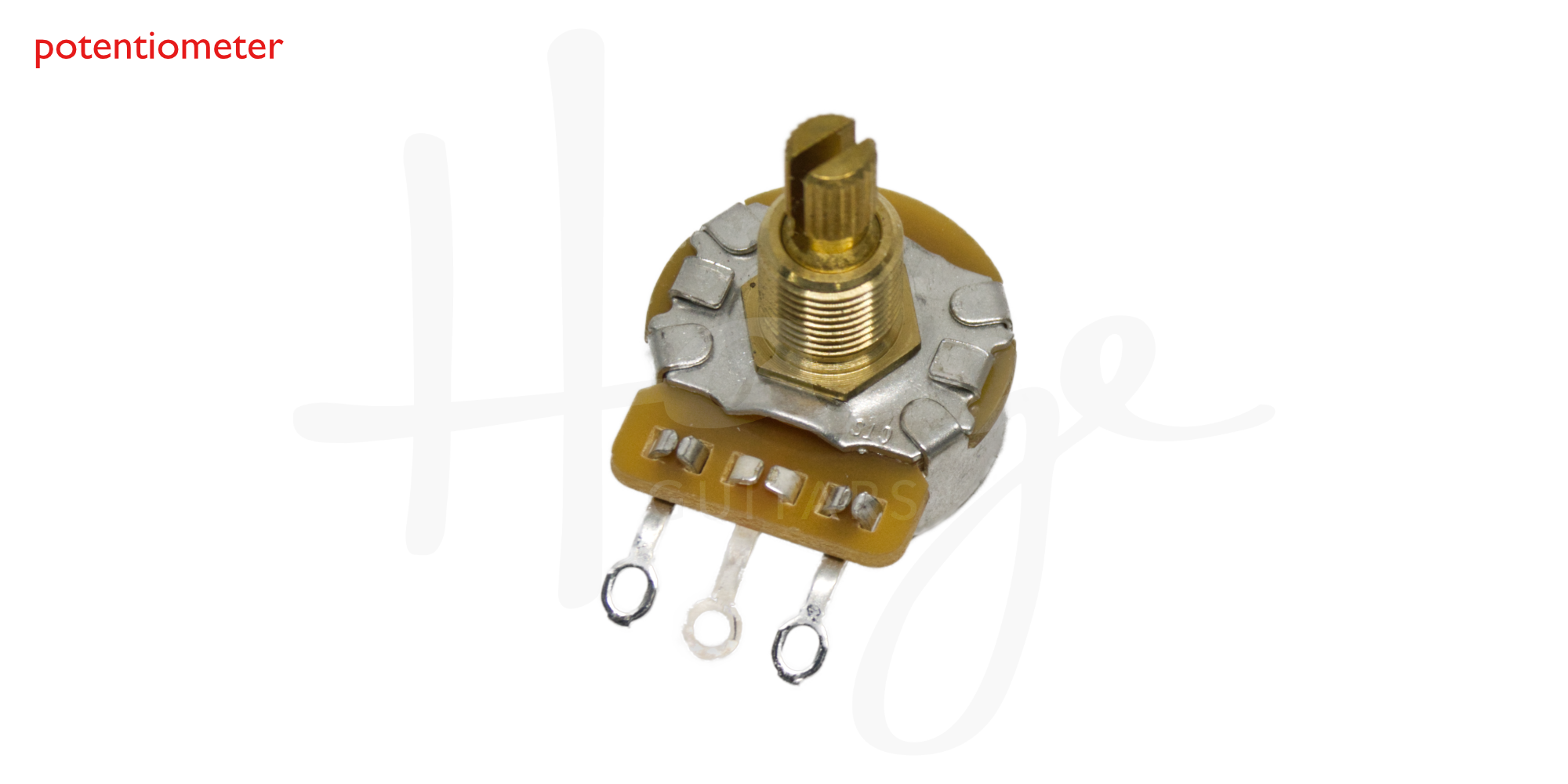
A potentiometer (or pot) is commonly used in guitar and bass circuits to control volume
You're probably familiar with the term. Pot is short for potentiometer and you can see why we might want to abbreviate that. A pot is a variable resistor—it allows us to control how much resistance is present in part of our guitar circuit and we can use it to control things like volume and tone.
Let's see how they work and then we can see how they might be used in our guitars.
How a potentiometer works
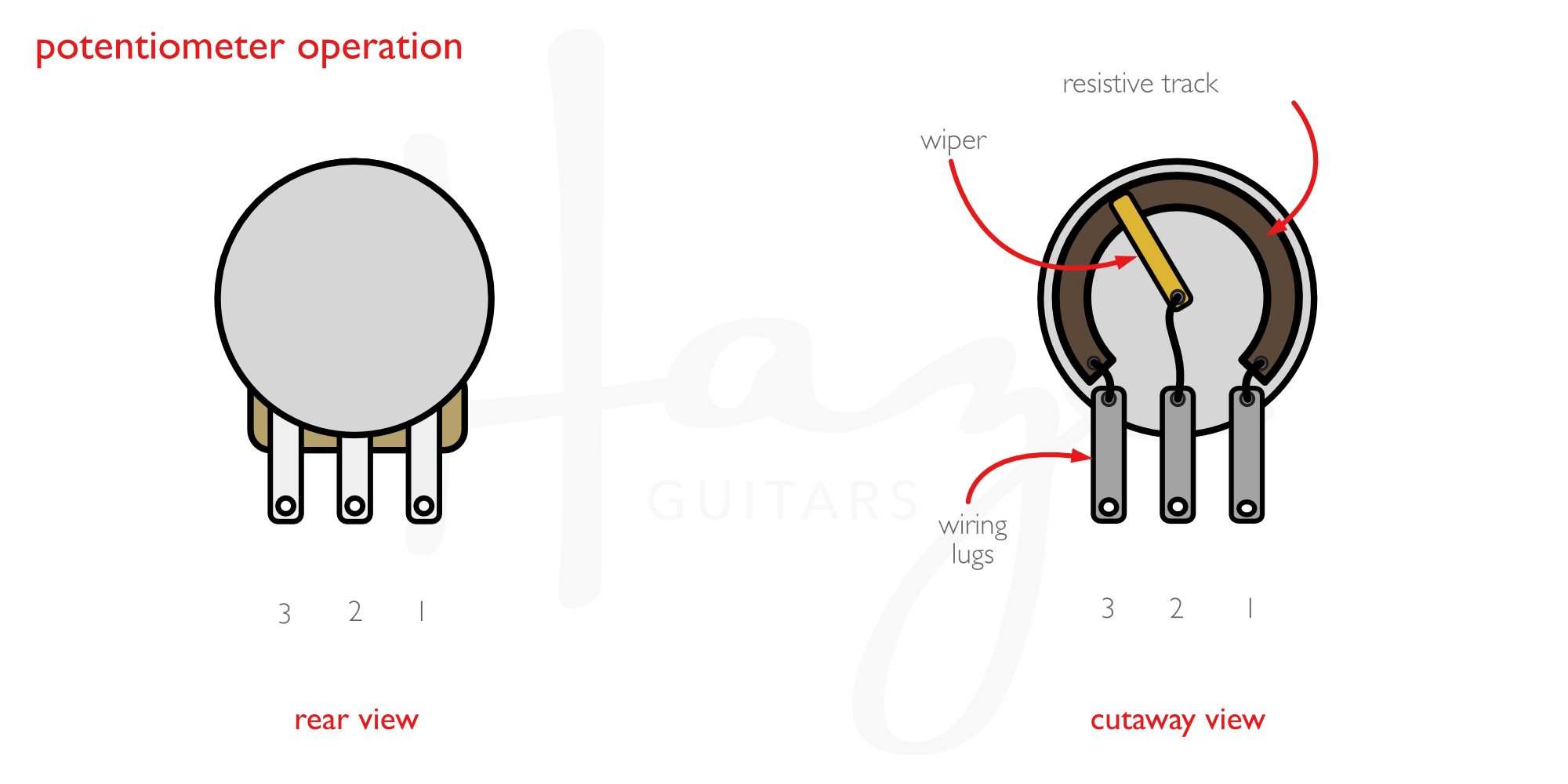
Pot rear view and cutaway view
In our guitars, we typically see pots from the back like the graphic above. We see a circular case with three wiring lugs poking out. We can solder wires to these lugs to achieve our various wiring aims.
Cut away the case and we can see a representation of what's going on inside the pot. The brown arc is a resistive track. We can see that one end of the track is connected to lug 3 and the other is connected to lug 1. This track is made to have a particular value of resistance.
At this point, we need a brief aside on resistance measurement.
Resistance is measured in ohms. We often use the symbol Ω to represent ohms (that's the Greek uppercase Omega).
When we discussed continuity testing, we talked about a very low resistance path. That varies a little from meter to meter but is probably somewhere below 1 or 2 ohms. And that is a very small resistance. Relatively speaking, an ohm is quite a tiny measurement. So tiny, in fact, that we're much more used to dealing in thousands of ohms.
For instance, a typical guitar pot might be 250,000 or 500,000 ohms. To save effort and space, these thousand-ohm measurements get indicated by the use of K or kilo. So 1,000 ohms can be 1KΩ (or 1 kilo-ohm). Our 500,000 ohm pot, we know better as a 500K pot.
And getting back to that pot, a common value for that resistive track I mentioned might be 500,000 ohms. Therefore, if we set our multimeter to its resistance function, measuring from point 3 to point 1 would read 500KΩ. Great.
The really clever bit, though, is that wiper connected to lug 2. As you turn the spindle in the middle of the pot, that wiper moves along the resistive track. So, if you were to measure the resistance between point 3 and point 2, it would vary depending on where the wiper was along the track. We have a variable resistor.
If the wiper were all the way clockwise, the resistance between point 3 and 2 would equal the total resistance of the pot because a signal would have to travel the full length of the resistive track. If the wiper were all the way counter-clockwise, the resistance would be (practically) zero because the signal can skip most of the track. Any position along the track will have a different value depending on how much of the track a signal has to traverse to get out again.
Using a pot in a guitar wiring circuit
To see how this can help us, let's step back a little first.
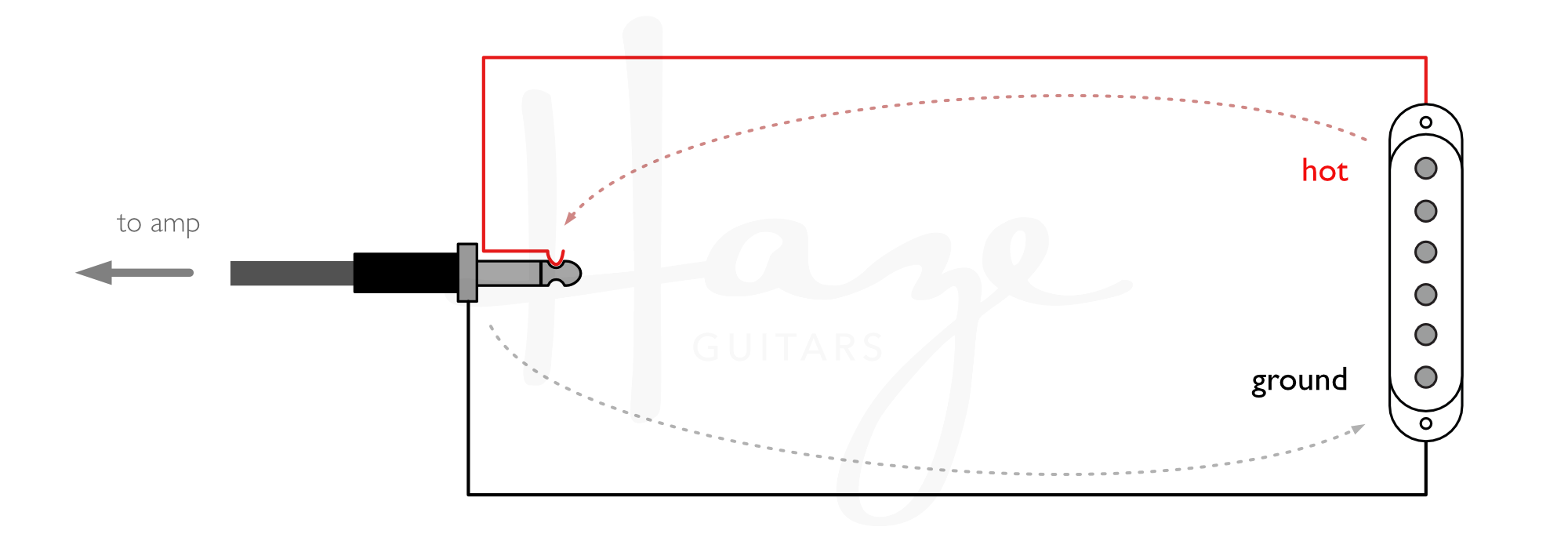
A basic guitar circuit
Above is an illustration of an incredibly basic guitar wiring circuit. The pickup makes a signal that travels out to the amp on the hot and back along the ground. Of course, real life is a little more complex but this works well as an example.
Let's say we want a way to shut off the sound going to our amp.
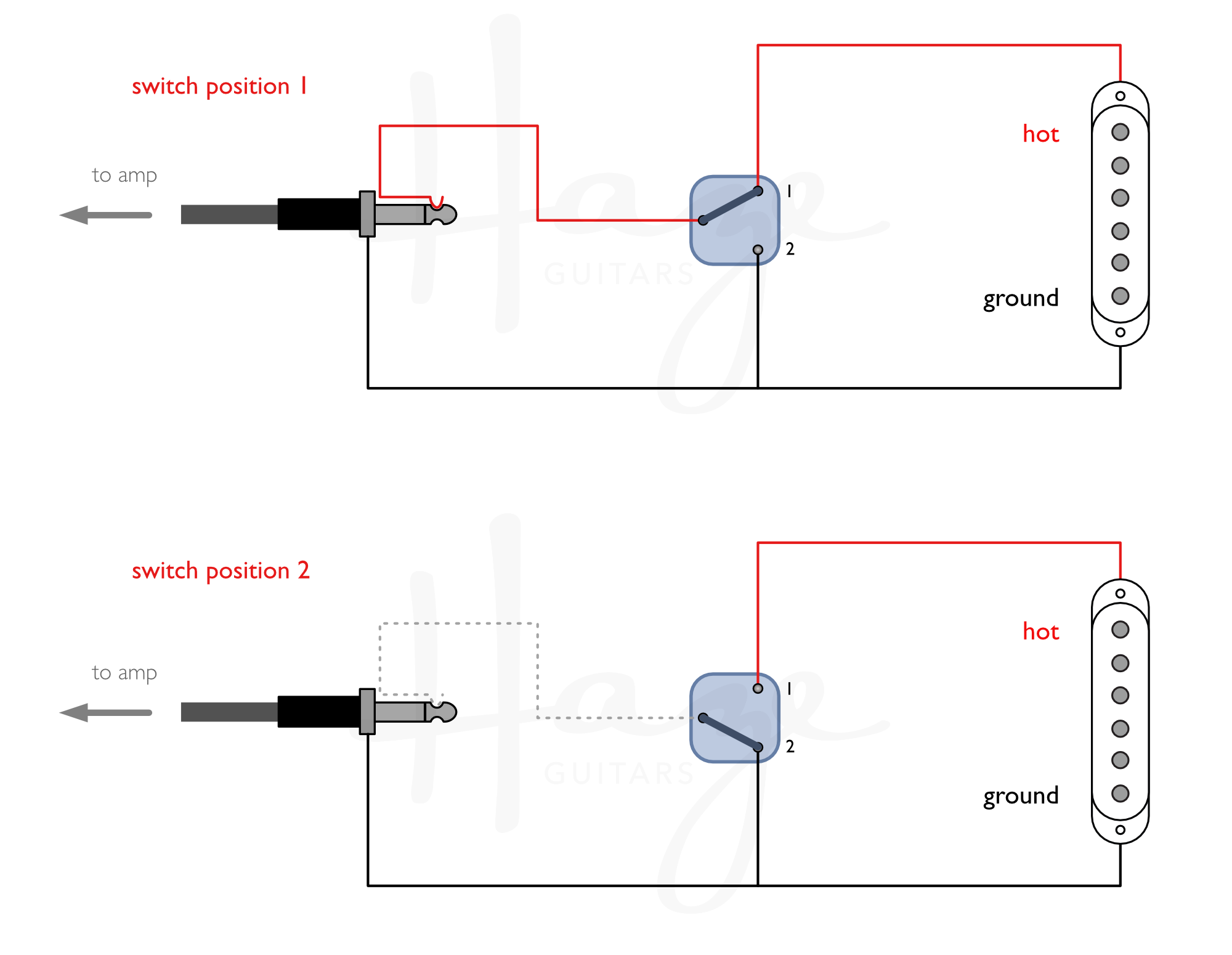
Illustration of using a switch to control ‘volume’ giving only on and off states
Well, we could add a switch into the circuit. If we have a switch on the hot wire from the pickup, in position 1, the circuit operates as before. Pickup signal shoots out on the hot wire to the amp and we have a wonderful noise. Flip the switch over to position 2 and suddenly there's no path to the amp for that pickup signal—the pickup circuit is broken. And, in fact, we've just connected the amp hot to ground, completely killing all possibility of getting a sound from it.
While an on/off switch works for this job, it's not the most useful way we could handle things. You see where we're going with this…
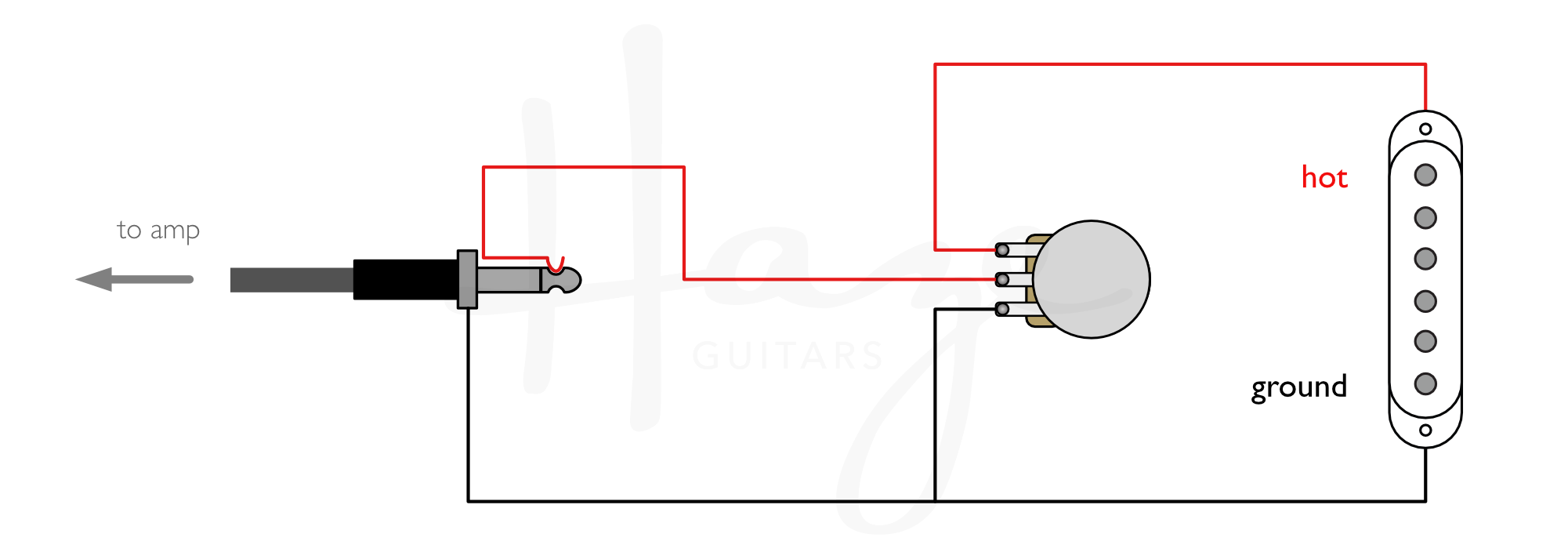
Using a potentiometer to control guitar volume
Sticking a pot in instead of the switch can achieve the same on and off states but, importantly, gives us a lot more flexibility between on and off. With the pot turned completely to 10, the input signal from the pickup hot wire skips the pot's resistive track and shoots out on the middle (wiper) lug. That's like our switch's ON state.
Turned all the way to what we think of as the zero position, the pot's full resistance is between the pickup hot wire and the amp output. At the same time, the amp's hot wire now has no resistance to ground and the signal is killed off. That's the same as our switch's OFF state.
Crucially, though, at different positions as the pot is turned, more or less of the pickup signal makes its way through the resistive track and out to the amp. The amount of signal is controlled by the wiper's position on the track and we get lots of varying states between ON and OFF. Hurrah for the volume control!
So, while we like seeing a low-resistance path in much of our circuit, there are times when more resistance can prove very useful to us.
And now a quick plug: If you find this stuff interesting, you'll probably enjoy my book, Complete Guitar Wiring. It's 400 pages worth of useful information to help understand and work on your guitar and bass wiring. It's good—people are saying nice things about it. 🙂 There's a digital version and a print version (or search your local Amazon for Complete Guitar Wiring or the ISBN 978-1919649429).
This article written by Gerry Hayes and first published at hazeguitars.com







Gibson’s addition of PCBs gets a lot of criticism. Is it justified? Mostly no but with a little bit of yes.