
Spot-Levelling: Giving Frets The Kiss-Off
My job involves a lot of dealing with uneven frets. As a player, you might have come across this from time to time. Sometimes it can be a whole series of unevenness in various locations all along the fingerboard and sometimes it can be just one fret. In the latter case, it can often be easy to diagnose as you're play each fret in turn—clean, clean, clean, CLUNK, clean… It's not always so cut and dry, of course, but when the fret gods throw you a bone with a single high fret you should grasp at it.
A single high fret means you can work in it in isolation. That's nice. In the past, repairers have filed a high fret or have fashioned some sort of mini-levelling device to get it down. That's fine and works well enough if you're careful. It can lack some precision though and it's not impossible to file too far, leaving the once high fret now lower than its neighbours.
In the past, I've generally filed carefully, sneaking up on the correct height and using fret-rocker to continually check things as I go. I use my wide three-corner fret file and it lets me pinpoint any high spots pretty easily (a high fret might not be high all along its length). This really needs care and continual checking but it's quite possible to knock back a high fret and get it pretty even.
I've never successfully made any sort of levelling device on this. I've heard of those who have but I've never been happy with my attempts. For a mini-leveller to address a single high fret, you need to have an abrasive part in the middle (that will file back the high fret) and a non-abrasive part on either side of that which will ride on the fret tops of the frets either side of the high one.
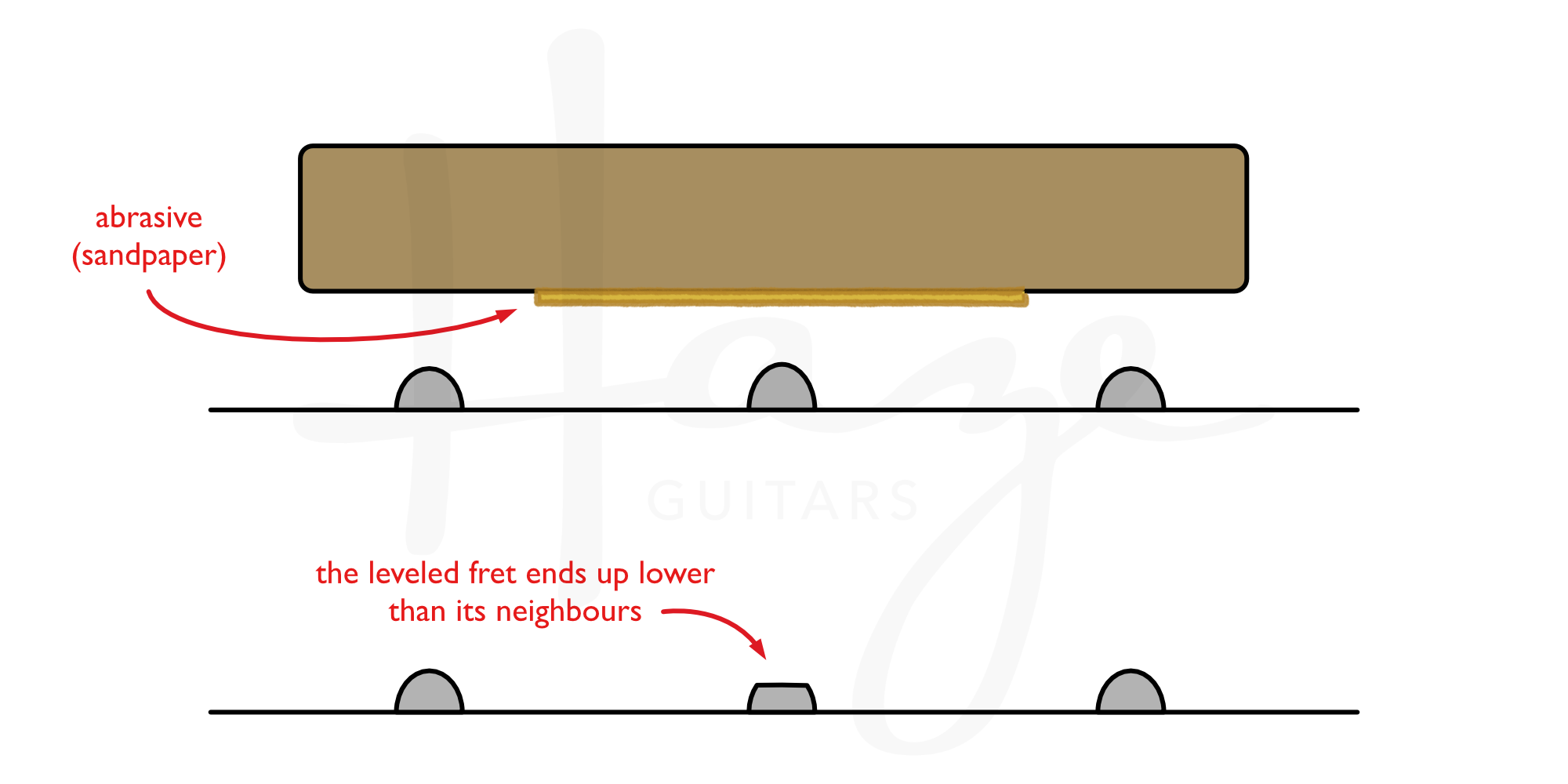
You can’t just add some sandpaper in the middle of a levelling tool
The problem is that any abrasive you have in the middle adds height to your levelling 'surface' the non-abrasive parts have to be built up to the height of the abrasive middle in order to give accurate results. You can't just stick a piece of sandpaper to the bottom of a block because the sandpaper would stick out too much and the newly levelled fret would be too low. I admit my attempts at this never felt precise enough.
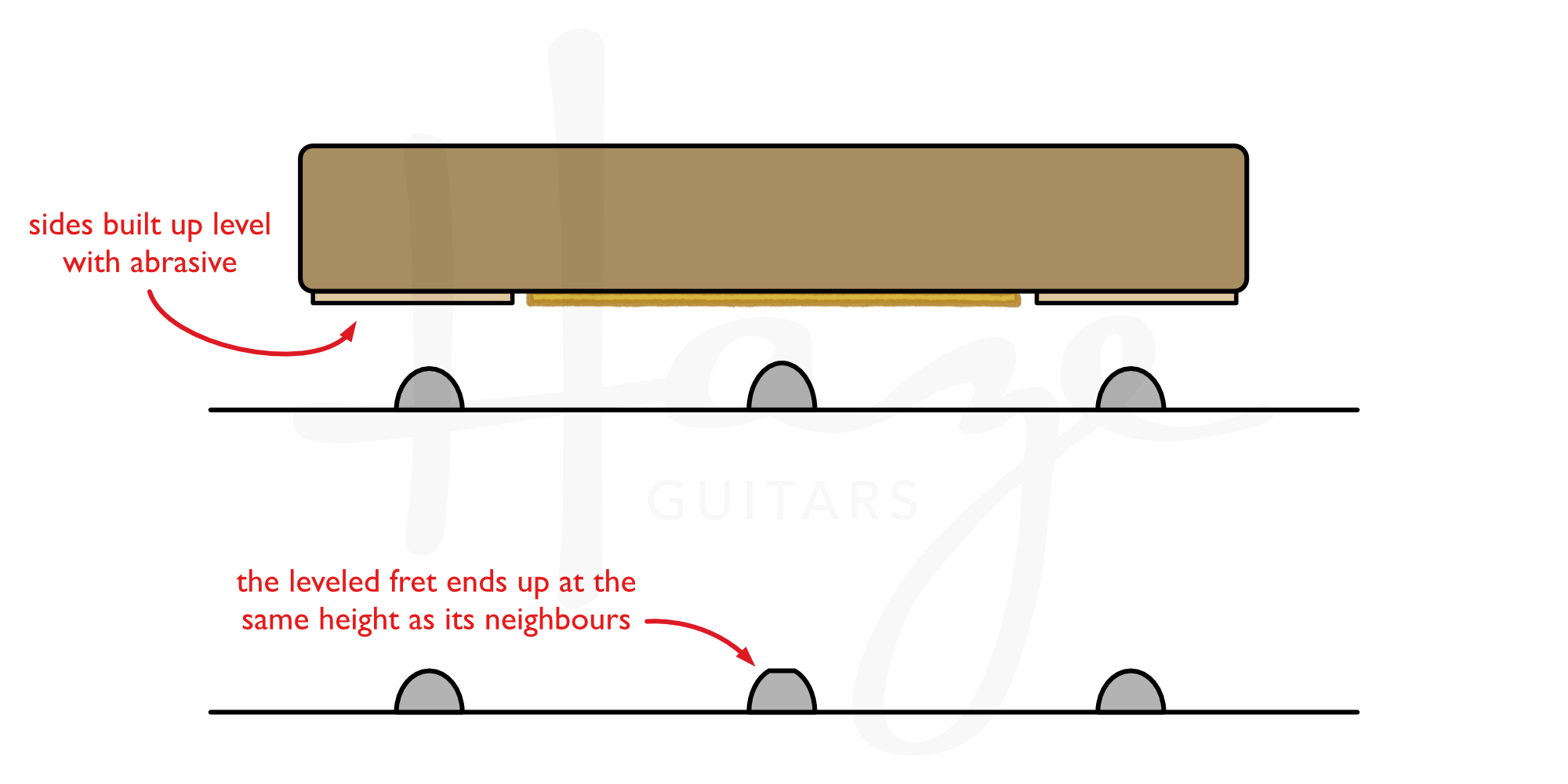
The sides of the levelling tool have to be the same height as the abrasive centre part
Since my first attempts at this, I was given a good tip. If you're using an adhesive like double-sided tape to stick your sandpaper to your little levelling block, you can flip a couple of pieces and stick them—abrasive side in— on either side. This should get you pretty close to a level surface along your levelling block. Do bear in mind that, as you use it, the sandpaper in the middle will wear and become slightly lower so you may need to replace it regularly.
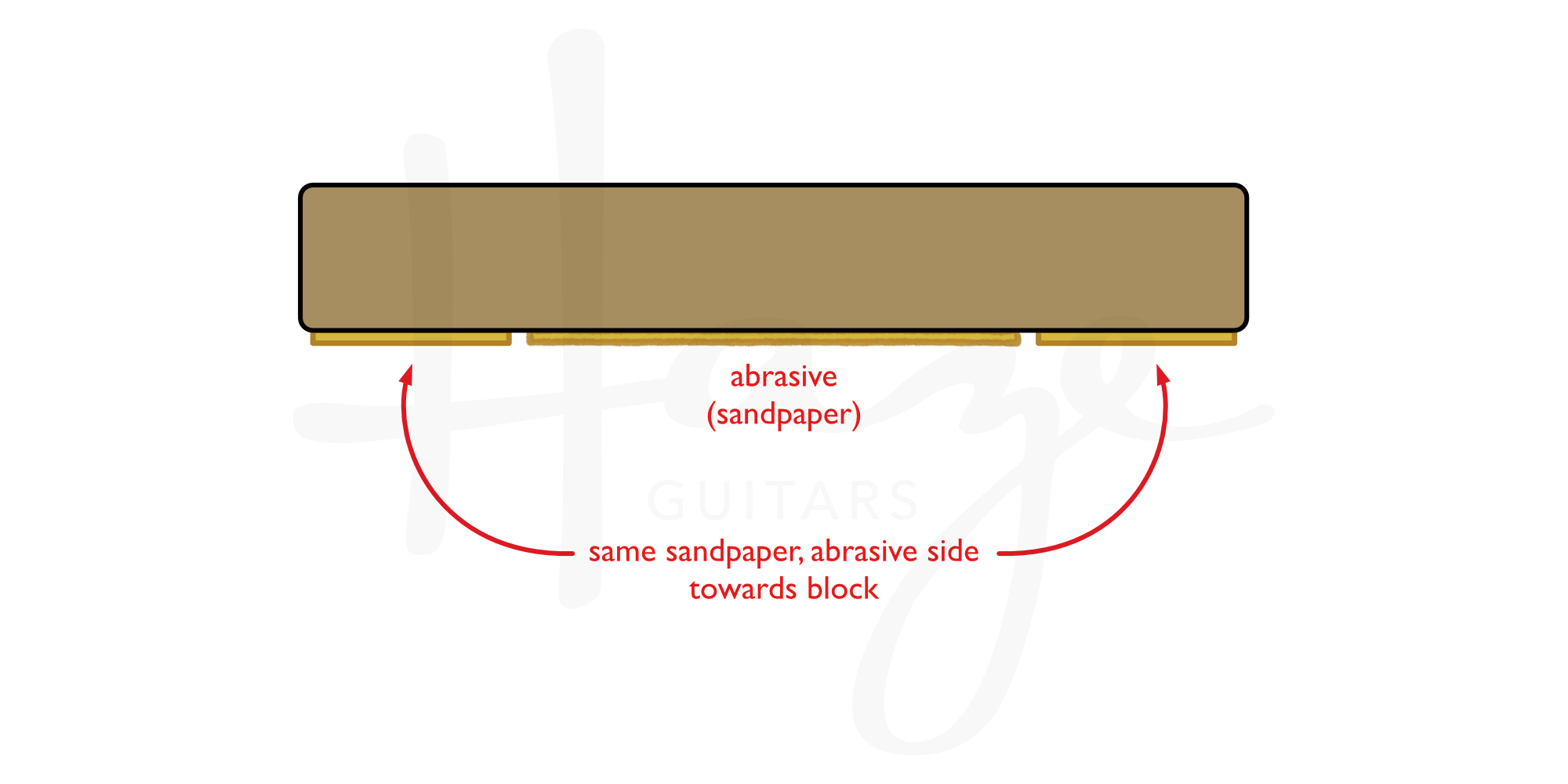
Flipping the same sandpaper for use at the sides can give similar height
As it happens, though, by the time I got this tip, I'd already moved on…

‘Fret-Kisser’ tool
Relatively recently, I shelled out on Stew Mac's Fret Kisser tool. It's like a thicker version of their Fret Rocker and shares an 'outline' with that tool. It has four edges of differing lengths so that it can span any three frets at a time along the length of the fingerboard. Cleverly, it differs from the Fret Rocker by having a short section of abrasive material in the middle of each edge. So, it's essentially a properly made version of the tool in the illustrations above.

Fret kisser in use
Here's a rather poor photo of the fret kisser in use. It's not cheap and is massive overkill for someone who has to level down a single fret every few years but for me, it's turned out to be a time saver. Of course, it's not always possible to deal with uneven frets in isolation but, when it is, this lets me be a little faster.
This article written by Gerry Hayes and first published at hazeguitars.com




Gibson’s addition of PCBs gets a lot of criticism. Is it justified? Mostly no but with a little bit of yes.